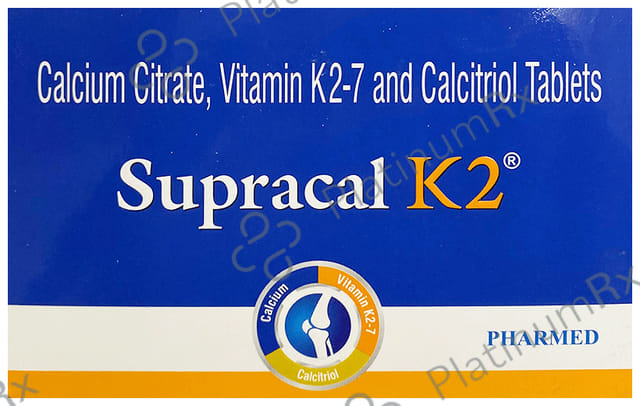
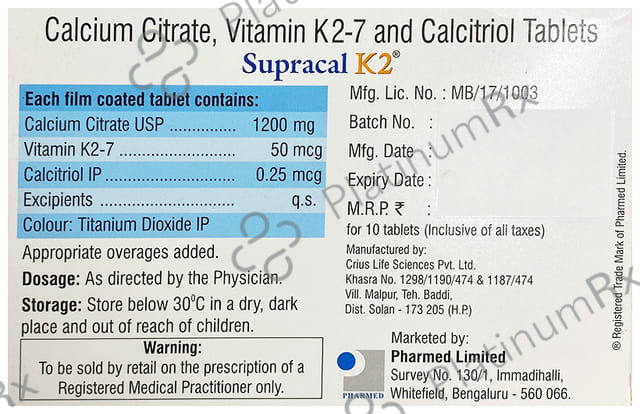
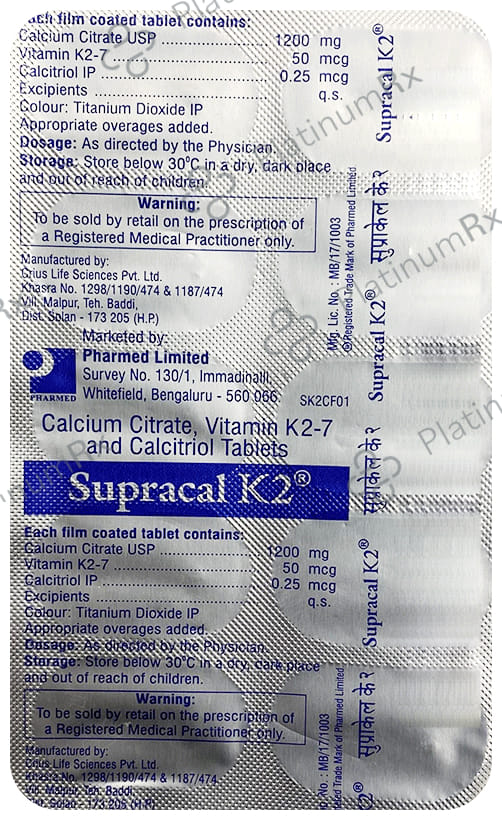
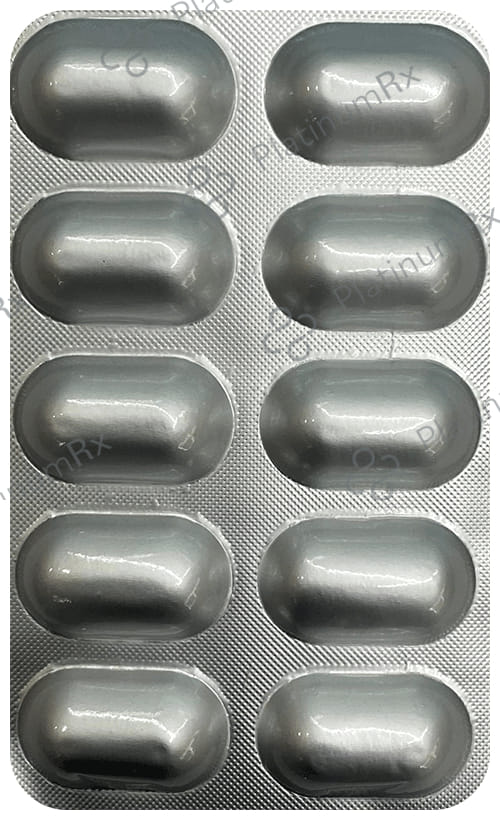
Supracal K2 1200mg/50/0.2mcg Tablet 10s

Supracal K2 1200mg/50/0.2mcg Tablet 10s is a bone health supplement combining elemental calcium (the structural mineral of bone), Vitamin D3 (cholecalciferol, which enables intestinal calcium absorption), and Vitamin K2 as menaquinone-7 (MK-7, the longest-acting form of vitamin K2, which activates the bone proteins that incorporate calcium into bone matrix). It is used to prevent and manage calcium and vitamin D deficiency, support bone health across the lifespan, and meet the increased needs of pregnancy, lactation, and ageing.
Written by: Syed Jommy Abbas, B. Pharma
Reviewed by: Dr. Rohit Kolhe, MBBS
Last updated on: 27-05-2026
Delivery by
...
WHO GMP Certified
Long Expiry (>8 Months)
15 Days Easy Returns
General Information
Genuine Medicine
Pay On Delivery
Secure Payment

LegitScript Certified Online Pharmacy

More About Supracal K2 1200mg/50/0.2mcg Tablet 10s
Quick Summary
Supracal K2 1200mg/50/0.2mcg Tablet 10s is a bone health supplement combining elemental calcium (the structural mineral of bone), Vitamin D3 (cholecalciferol, which enables intestinal calcium absorption), and Vitamin K2 as menaquinone-7 (MK-7, the longest-acting form of vitamin K2, which activates the bone proteins that incorporate calcium into bone matrix). It is used to prevent and manage calcium and vitamin D deficiency, support bone health across the lifespan, and meet the increased needs of pregnancy, lactation, and ageing.
Detailed Description
Bone is a living tissue continuously being broken down and rebuilt. Adequate calcium, vitamin D, and vitamin K all play distinct, complementary roles in this process. A deficiency of any one of them limits the effectiveness of the others.
Single calcium doses of 500 mg or less are absorbed more efficiently than larger boluses, so splitting daily intake across two meals is helpful when total daily calcium is high.
Vitamin D3 (cholecalciferol) is the form of vitamin D synthesised in skin upon sunlight exposure and obtained from animal foods. It is converted in the liver to 25-hydroxyvitamin D and then in the kidney to its active form, calcitriol, which drives intestinal calcium absorption.
Vitamin K2 as menaquinone-7 (MK-7) is a long-chain menaquinone produced by bacterial fermentation (such as in natto, the traditional Japanese fermented soybean). MK-7 has a longer half-life than other vitamin K forms, meaning a single daily dose can support vitamin K-dependent activity over 24 hours.
Uses of Supracal K2 1200mg/50/0.2mcg Tablet 10s
- To prevent and manage calcium and vitamin D deficiency.
- To support nutritional therapy in osteopenia and osteoporosis.
- For postmenopausal bone health alongside lifestyle measures.
- To meet increased calcium and vitamin requirements during pregnancy and lactation.
- For recovery support after fractures or orthopaedic surgery, under medical guidance.
Benefits of Supracal K2 1200mg/50/0.2mcg Tablet 10s
- Calcium supplies the raw mineral for the bone matrix.
- Vitamin D3 enables active intestinal calcium absorption.
- Vitamin K2 as MK-7 activates osteocalcin (which incorporates calcium into bone) and matrix Gla protein (which helps prevent calcium deposition in arteries).
- MK-7's long half-life supports once-daily dosing.
- Generally well tolerated with a long clinical track record for the underlying nutrients.
Side Effects of Supracal K2 1200mg/50/0.2mcg Tablet 10s
Common
- Constipation, bloating, or mild stomach upset
- Nausea if taken on an empty stomach
- Mild loose stools
Uncommon
- Loss of appetite
- Headache
- Dry mouth
Serious side effects requiring immediate attention
- Hypercalcaemia (high serum calcium) with prolonged high-dose use
- Vitamin D toxicity from chronic high-dose use
- Kidney stones in those predisposed
- Severe allergic reaction
Directions for Use
Take Supracal K2 1200mg/50/0.2mcg Tablet 10s orally once or twice daily, with or just after a meal — this improves absorption and reduces stomach upset. Vitamins D3 and K2 are absorbed better with food containing some fat. Single calcium doses of 500 mg or less are absorbed more efficiently than larger boluses. Maintain adequate hydration during use, and combine with a balanced diet and regular weight-bearing activity.
How it works
Calcium is absorbed in the small intestine through an active vitamin D-dependent pathway in the upper small intestine and a passive paracellular route along the length of the small bowel. Absorbed calcium adds up to the body's calcium pool, supporting bone mineralisation by osteoblasts (bone-forming cells), and is available for nerve transmission, muscle contraction, blood clotting, and many enzymatic reactions.
Vitamin D3 is converted in the liver to 25-hydroxyvitamin D and in the kidney to calcitriol. Calcitriol binds the vitamin D receptor in intestinal cells, switching on the calcium-binding proteins and channels that significantly enhance active calcium absorption.
Research reveals that activating osteocalcin to incorporate calcium into bone matrix is more important than simply supplying calcium itself, because unactivated osteocalcin cannot bind calcium to bone, regardless of how much calcium is available.
Vitamin K2 as MK-7 acts as a cofactor for the enzyme gamma-glutamyl carboxylase, which adds carboxyl groups to specific glutamate residues on vitamin K-dependent proteins. Two of these are critical for bone health: osteocalcin (which binds calcium into the bone matrix) and matrix Gla protein (which helps prevent calcium deposition in arterial walls). MK-7's long half-life means a single daily dose maintains vitamin K-dependent activity around the clock.
Safety Advice for Supracal K2 1200mg/50/0.2mcg Tablet 10s

Allergy
Unsafe
Avoid in known hypersensitivity to any component or excipient.

Breastfeeding
Safe
Safe at recommended doses; avoid mega-doses.

Pregnancy
Safe
Commonly prescribed during pregnancy; use as advised.

Driving
Safe
No known effect on alertness or driving.

Alcohol
Caution
Heavy intake reduces calcium and vitamin D absorption.

Liver
Caution
Severe liver disease may impair vitamin D and K activation.

Kidney
Caution
Risk of hypercalcaemia and vascular calcification in CKD.

Children
Caution
Use only as prescribed; paediatric doses differ.

Elderly patients
Safe
Often beneficial due to reduced sun exposure and absorption.
Drug-Food Interaction
- High-oxalate foods (spinach, rhubarb) (CAUTION): Oxalates bind calcium in the gut, forming insoluble complexes that reduce absorption.
- Bran and high-phytate foods (CAUTION): Phytates chelate calcium and lower its bioavailability when taken together.
- Caffeine and alcohol (CAUTION): Both increase urinary calcium excretion and reduce net calcium retention with excess intake.
- Foods with healthy fats (BENEFICIAL): Dietary fat enhances intestinal absorption of the fat-soluble vitamins D3 and K2-7.
Interactions with Other Drugs
- Warfarin (SEVERE): Vitamin K2-7 directly works against the warfarin's anticoagulant effect, requiring INR (time taken to clot the blood) monitoring and dose adjustment.
- Levothyroxine (SEVERE): Calcium binds to levothyroxine in the gut and reduces its absorption; separate doses by at least 4 hours.
- Tetracyclines and fluoroquinolones (SEVERE): Calcium chelates these antibiotics, drastically reducing their bioavailability; separate by 2–4 hours.
- Bisphosphonates (SEVERE): Calcium binds bisphosphonates in the gut and prevents absorption. You should take bisphosphonate first and then Supracal K2 1200mg/50/0.2mcg Tablet 10s at least 2 hours later.
- Iron supplements (CAUTION): Calcium competes with iron for intestinal uptake, reducing iron absorption. Separate the two by 2 hours.
- Thiazide diuretics (CAUTION): They reduce urinary calcium excretion, raising the risk of hypercalcaemia with supplementation.
- Digoxin (CAUTION): Hypercalcaemia sensitises the myocardium to digoxin and increases the risk of toxicity and arrhythmia.
- Proton pump inhibitors and H2-receptor antagonists (CAUTION): Low gastric acidity impairs the dissolution and absorption of calcium carbonate. Calcium citrate is preferred in such patients.
- Systemic corticosteroids (CAUTION): They reduce intestinal calcium absorption and increase urinary loss, raising long-term fracture risk.
- Aluminium- and magnesium-containing antacids (CAUTION): They alter calcium absorption and disturb mineral balance when used simultaneously for a long period. Separate the two by several hours.
- Orlistat (CAUTION): Reduces absorption of fat-soluble vitamins D3 and K2-7; separate intake by at least 2 hours.
- Broad-spectrum antibiotics (CAUTION): Prolonged use can suppress gut flora that produce vitamin K.
Drug-Disease Interactions
- Hypercalcaemia and primary hyperparathyroidism (CONTRAINDICATED): Baseline serum calcium is already elevated, and supplementation worsens it, risking arrhythmia and renal injury.
- Sarcoidosis and other granulomatous diseases (CONTRAINDICATED): Activated macrophages produce extrarenal calcitriol, making patients prone to vitamin D-induced hypercalcaemia (high calcium levels in blood).
- History of calcium-based kidney stones (CAUTION): Added calcium load may promote recurrent stone formation unless balanced with adequate hydration.
- Chronic kidney disease (CAUTION): Impaired calcium-phosphate handling increases the risk of hypercalcaemia and vascular calcification (mineral deposition in the arteries or veins).
Overdose
Overdose can cause hypercalcaemia, which may manifest as nausea, vomiting, abdominal pain, constipation, excessive thirst, increased urination, weakness, confusion, irregular heartbeat, and vitamin D toxicity with chronic high-dose use. Suspected overdose requires medical evaluation, including measurement of serum calcium, vitamin D, and kidney function.
What If You Forget to take Supracal K2 1200mg/50/0.2mcg Tablet 10s?
If you miss a dose, take it as soon as you remember on the same day with a meal. If it is close to the next dose, skip the missed dose and continue. Do not double the dose.
FAQ
References
- https://ods.od.nih.gov/factsheets/Calcium-HealthProfessional/
- https://ods.od.nih.gov/factsheets/VitaminD-HealthProfessional/
- https://ods.od.nih.gov/factsheets/VitaminK-HealthProfessional/
- https://www.ncbi.nlm.nih.gov/books/NBK536983/
- https://www.nhs.uk/conditions/osteoporosis/
- https://my.clevelandclinic.org/health/articles/15050-calcium--vitamin-d-supplements
Fact Box
Action Class
Bone health nutritional supplement
Chemical Class
Calcium salt (elemental calcium); secosteroid (cholecalciferol); long-chain menaquinone (MK-7)
Habit Forming
No
Disclaimer
PlatinumRx is committed to providing reliable and accurate information to support informed customer decisions. However, all information made available on the Platform, including product descriptions, comparisons, and other content, is provided solely for general informational purposes. Such information is not intended to diagnose, prevent, treat, or cure any medical condition, nor should it be relied upon as a substitute for professional medical advice, diagnosis, or treatment.
Customers also bought

Health Articles


More Medicines By Manufacturer
More Medicines With Salt
Top Selling Medicines
Top Selling Devices